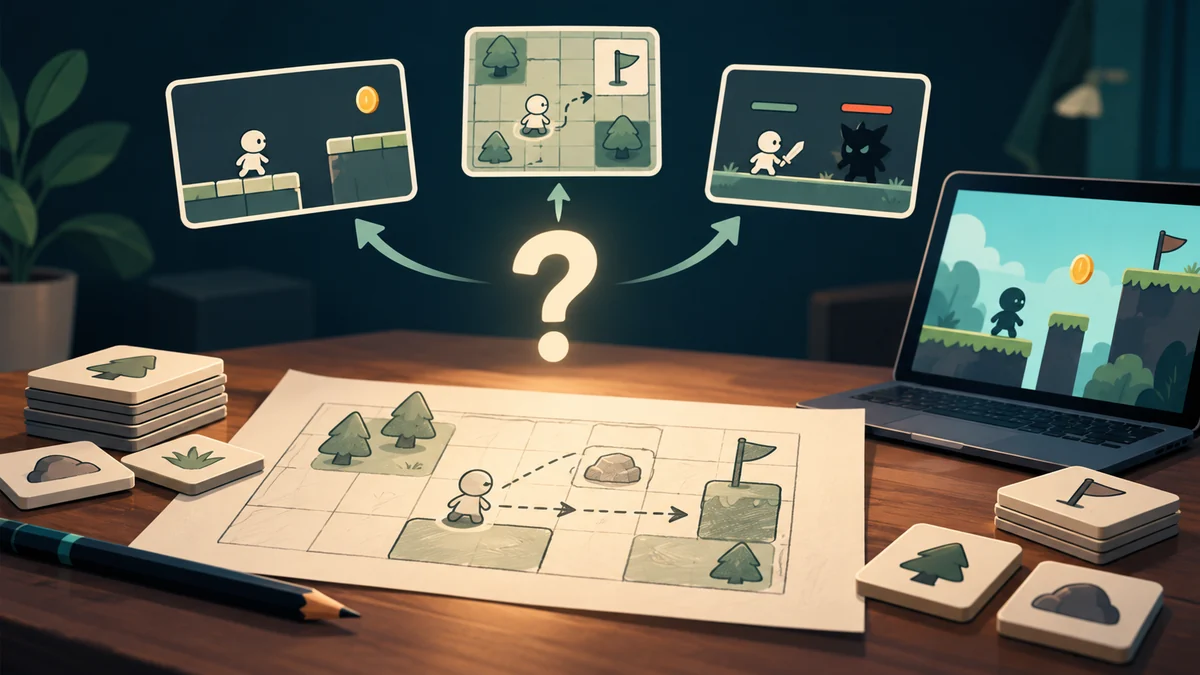
Choose one prototype question
A prototype should answer a design question rather than imitate a finished product. For a card game, that might mean whether choosing between two legal cards feels interesting. Placeholder art and a short loop can be enough if they preserve the decision you need to observe.
For a card game, ask whether choosing between two legal cards requires interesting thought. The prototype needs two options, their consequences and another opportunity to choose. Accounts and ten card-back styles do not answer that question. Removing essential information would also invalidate the exercise. Simplification removes irrelevant work rather than the context that gives a decision meaning. Put the question above the task list so every proposed addition has a clear relevance test.
Keep what influences the decision
Prototype a choice between two cards using simple rectangles and labels. Ask someone to make the choice and explain what trade-off they noticed. If there is no meaningful trade-off, more artwork is unlikely to create one by itself. Change the decision or consequence and repeat. Keep the test focused so the lesson is about the mechanic rather than opinions on temporary visual polish.
Instead of asking only whether it was good, observe information use, pauses and whether the player connects the result to their choice. Ask what they expected from the other card. Always choosing one option may mean it is obviously superior or that the distinction is unclear. Those causes require different changes. Compare observations with the initial assumption. A small prototype explores a design question; a few sessions cannot establish the future popularity of the whole product.
Connect observations to a change
For the next pass, change one important variable, such as a card’s cost or the clarity of its consequence. Simultaneous changes to rules, artwork and speed make differences harder to interpret. Keep the earlier version and record what each taught you. Once the question is answered, stop endlessly decorating the prototype. It may support a fuller route or justify abandoning the idea. A prototype that exposes a weak assumption has delivered useful information.
Further reading: Unity: Introduction to scenes
For a related example, read Dalo’s Shared Core: One Table, Several Games.