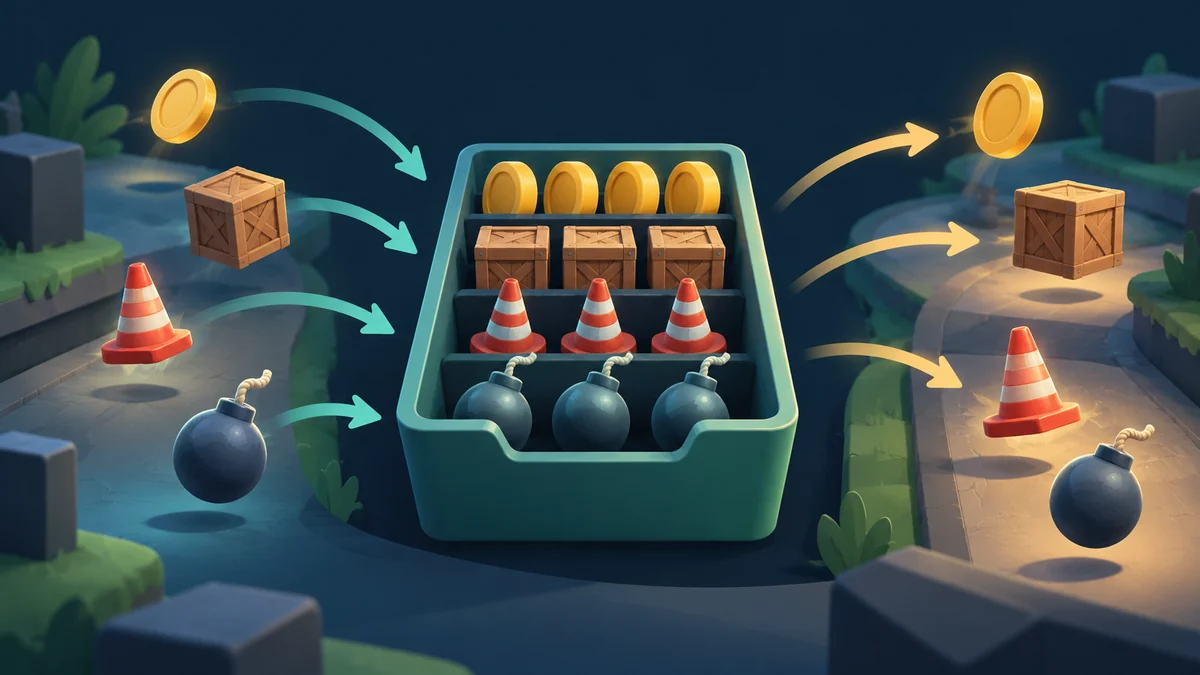
Is the reward coin ready for its second use?
Pooling keeps objects available for reuse instead of creating and destroying them for every short appearance. Unity provides pool APIs, but the important design contract is reset behavior. A reused reward effect should start with the correct position, visibility and callback state.
Imagine reward coins flying from the screen center to the balance. Repeated object creation and destruction can have costs; pooling retains instances for reuse. A used instance differs from a fresh one, though. It may remain at the previous destination, small, invisible or connected to an old callback. List what must be prepared when obtaining it and stopped when returning it. Without that contract, reuse becomes a route for carrying stale behavior into the next reward.
Reset before reuse
Reuse one reward effect several times at different positions. On every activation, check position, alpha, scale and active callbacks. Release it during motion and acquire it again. This deliberately awkward sequence tests reset responsibility rather than only the happy path. If pooling does not address a measured cost, retain the simpler lifecycle until there is evidence that reuse is worth the added management.
Run a second reward immediately after the first, then interrupt one in motion. Does the coin return correctly? Can an old completion callback still add points? Define whether an in-use object can be obtained again. Unity pool APIs assist collection management, but do not author your listener, animation and reward-state cleanup. Acquisition and release must match the effect’s real lifetime, especially when the player leaves the screen.
Pool for an observed need
Retained objects also consume memory, so unlimited pool growth is not an automatic solution. Observe concurrent demand and what happens under pressure. Pool complexity may not suit a rarely opened dialog. Measure one repeated effect first and limit the experiment to it. Completion should show both useful cost behavior and correct second-use behavior. If only the first appearance looks right, the reset contract remains incomplete.
Further reading: Unity: Pooling and reusing objects
For a related example, read Frame Time: Why Average Speed Is Not Enough.