After Hokm, a game with its own character
In my development sequence, Joker came after the shared core, Hokm, menus, coins, customization and analytics. By then, Dalo already had many of the things a card game needs, but a new game still required its own character. I liked being able to avoid starting from scratch while also avoiding forcing Joker into Hokm’s structure. Cards, player hands and selected presentation systems could be reused. Drawing, pairing and the game’s ending needed to be defined in Joker’s own layer.
This time the last Joker matters
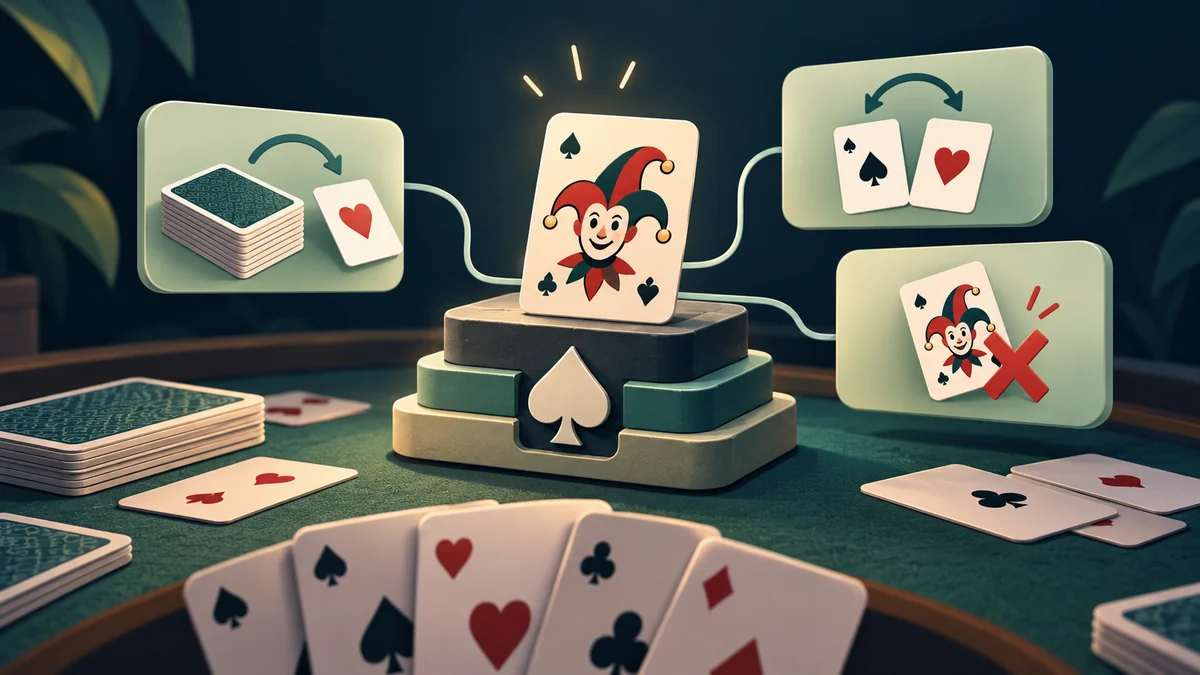
This version of Joker is an offline game with one human player and three bots. Players draw cards and remove pairs from their hands. Its objective differs from Hokm: the person holding the sole Joker at the end loses. Winning a trick with trump cards or teammate relationships could not therefore form the basis of its logic. That difference helped me revisit the core’s boundary. The shared system can maintain turns and cards, but cannot assume that every card game has teams, a trump suit or the same way of determining a winner.
Empty hands and turn rotation
One area that needed a new meaning was turn progression. When a player’s hand becomes empty, they should no longer remain in the active rotation like someone who still has cards. Meanwhile, the game continues until the final Joker’s situation is clear. These may sound like small details, but they turn a demonstration of drawing cards into a complete flow. In Hokm, I had focused on legal moves and trick winners. In Joker, empty hands and the last remaining card have different roles. Reusing the foundation was useful only if those differences survived.
Reuse while preserving differences
Joker became another example of Dalo’s original aim: several games with a coherent overall experience and independent rules. I did not have to rebuild the card system and every presentation element. Instead, I could focus on actions specific to this game. A ready foundation does not finish a new game automatically, however. Logic, ending conditions and their connection to presentation still need their own work. Alongside Joker, my teammate’s Pasur implementation is also part of the collection’s development. Visit the Dalo page to follow the path from the first card to these games. Each has tested the same foundation in a different way.